
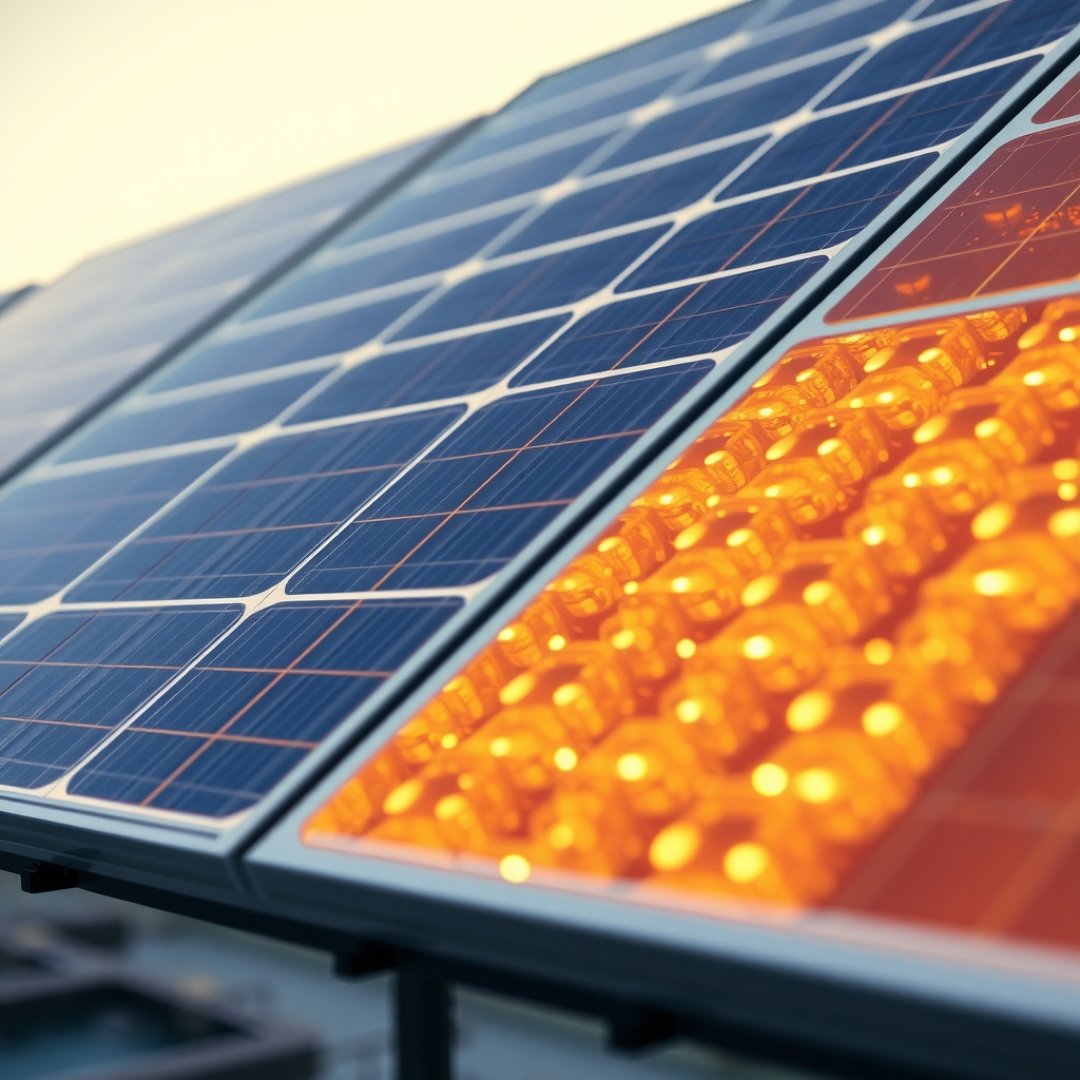
The integration of Perovskite Tandem Photovoltaics into utility-scale solar arrays has reached a pivotal juncture in 2026, challenging traditional crystalline silicon dominance. By stacking a wide-bandgap perovskite layer on top of a standard silicon base, researchers have successfully pushed laboratory efficiency records beyond the 33% threshold. This multi-junction architecture utilizes spectral splitting to capture high-energy photons that are typically lost as heat in single-junction cells. As manufacturing shifts from small-scale prototyping to industrial-grade roll-to-roll processes, the engineering focus has pivoted decisively toward mitigating extrinsic degradation pathways. Achieving commercial-grade stability now requires precise encapsulation strategies and defect passivation techniques that ensure 25-year service life requirements are met without sacrificing the substantial gain in kilowatt-hour output per square meter.
Spectral Engineering and Efficiency Metrics
Optimizing Bandgap Tunability
Perovskite Tandem Photovoltaics derive their superiority from the ability to tune the bandgap of the perovskite absorber. By adjusting the lead-tin ratio or halide composition, developers can precisely match the absorption spectrum to complement the underlying silicon bottom cell.
- Voltage Gains: Multi-junction cells exhibit significantly higher open-circuit voltages (Voc), reducing thermalization losses.
- Spectral Matching: The perovskite top layer captures high-energy visible light, while the silicon bottom layer remains efficient in the near-infrared.
- Efficiency Ceiling: Current commercial prototypes are hitting 29% conversion efficiency in field conditions, surpassing the Shockley-Queisser limit for pure silicon.
Scaling Production and Stability Challenges
Environmental Robustness
The primary hurdle for widespread deployment remains the moisture and thermal sensitivity of perovskite crystalline structures. Advances in 2026 have introduced advanced atomic layer deposition (ALD) barriers that seal the modules against humidity ingress.
Key Stability Mechanisms:
- Passivation Layers: Organic-inorganic interface engineering suppresses ion migration, a leading cause of hysteresis.
- Encapsulation Standards: Adoption of IEC 61215 accelerated aging protocols verifies that modules can withstand high-temperature humidity cycles.
- Manufacturing Economics: High-throughput slot-die coating processes have reduced the CAPEX requirements, positioning these cells as a cost-effective upgrade for existing silicon production lines.
Grid Integration and Economic ROI
Assessing Levelized Cost of Energy
For system integrators, the value proposition of Perovskite Tandem Photovoltaics is defined by the reduction in the Levelized Cost of Energy (LCOE). Because these modules pack more power into the same footprint, they reduce balance-of-system (BOS) costs, including land preparation, racking, and cabling.
Financial Impact:
- Power Density: Increased output per module reduces the total count of components per megawatt, lowering installation labor.
- Grid Compatibility: The output characteristics are sufficiently similar to standard silicon to be integrated into existing inverter architectures without modifying IEEE 1547 compliance hardware.
- Long-term Yield: Despite higher initial CAPEX compared to standard mono-PERC, the superior efficiency provides an estimated 12-15% improvement in lifetime energy production.
Frequently Asked Questions
What is the primary benefit of Perovskite Tandem Photovoltaics over standard silicon cells?
The primary benefit is superior energy conversion efficiency, achieved by capturing a broader spectrum of solar radiation via a dual-junction architecture.
Are Perovskite Tandem Photovoltaics durable enough for long-term outdoor use?
Yes, with advancements in encapsulation and defect passivation in 2026, these cells are now passing rigorous IEC 61215 stability tests for commercial deployment.
How does the increased efficiency impact project economics?
Higher energy density allows for a smaller physical footprint per megawatt, significantly lowering balance-of-system costs and improving the overall project LCOE.